
By Benoit Descary · June 26, 2026 · Guide
AI Recipe Generator: How to Get a Recipe That Works With What You Have
An AI recipe generator writes a custom recipe, with ingredients, quantities and steps, from whatever you tell it: what’s left in the fridge, a craving, a time limit or an allergy. It doesn’t look up an existing recipe; it composes a new one. That’s its strength, because it fits your exact situation, and its weak spot, because a recipe nobody has cooked yet can carry a wrong quantity or cooking time. Used well, it answers “what’s for dinner?” in under a minute.
Finding a recipe vs. generating one
Two kinds of tools get lumped together. Ingredient search sites dig through recipes that already exist and show the ones that contain what you typed. AI generators write a new recipe around exactly what you have. Both are useful, and knowing which one to open saves a lot of disappointment.
| What matters | Search by ingredients | AI recipe generator |
|---|---|---|
| Where the recipe comes from | A database of published recipes | Written for you, on request |
| Uses exactly what you have | Rarely: one or two items are usually missing | Yes, that’s the starting point |
| Already tested | Often, with reviews | No, which is why you check it |
| Allergies, time, equipment | Through filters, when they exist | In the request, in one sentence |
| Asking for a variation | Start a new search | “Faster”, “no oven” or “for six” is enough |
| Where it shines | Baking, classic dishes | Weeknight dinners, leftovers, several constraints at once |
How to phrase your request
A generator answers the question you ask, not the one you meant. “A chicken recipe” gets you a chicken recipe, probably a dull one, possibly calling for three things you don’t own. A useful request fits in a sentence or two and covers five things: what you have, what to avoid, how much time you’ve got, your equipment and how many people are eating.
Compare: “I have four chicken thighs, half a butternut squash, two onions and a can of coconut milk. Thirty minutes max, one skillet, two adults and a kid who hates spicy food.” This time the recipe comes back with sensible quantities, no chili, no oven, and it finally uses up the squash that was starting to worry you.
The best results often take two rounds. The first answer gives you a base and the second adjusts it: “swap the rice for pasta, I’m out”, “make enough for tomorrow’s lunches”, “dairy-free please”. That back-and-forth is where AI gets genuinely handier than a cookbook.
Check the recipe before you cook: a 30-second read
A generated recipe is a solid first draft. Before you turn on the stove, read it with four questions in mind.
- Do the quantities make sense for the number of servings? A tablespoon of salt for two people, or 1.5 lb of pasta for two, should make you raise an eyebrow.
- Is every ingredient in the steps also in the list? A random “add the parmesan” shows up more often than you’d think.
- Are the cooking times believable? Cubed potatoes don’t cook through in eight minutes in a pan.
- Does the meat reach a safe temperature? The USDA calls for 165 °F (74 °C) for poultry and 160 °F (71 °C) for ground beef and pork. A thermometer settles it.
What AI does better than a cookbook
It adapts. A recipe for four becomes a recipe for seven with no mental math, the cream becomes coconut milk if that’s what you have, and an oven method turns into an air fryer one if that’s what you’d rather use on a weeknight. It also juggles several constraints at once, which no cookbook index can: vegetarian, nut-free, ready in twenty minutes, and using the spinach that has to go today.
It helps you clear out the fridge, too. Starting from what’s about to spoil, instead of from a recipe that needs a store run, is one of the simplest ways to waste less food at home.
Its real limits
It has never tasted what it suggests. A bold combination can sound great and fall flat on the plate. For a Tuesday dinner, no big deal. For guests, a proven recipe is the safer bet.
Baking is its weak spot. A stir-fry forgives a rough estimate, a cake much less: the ratios of flour, fat, eggs and leavening are close to chemistry. For a dessert that matters, a tested recipe is still the best choice.
And AI can’t read labels. If someone at your table has an allergy, it can leave the ingredient out of the recipe, but it’s up to you to check that a store-bought broth or sauce doesn’t carry traces of tree nuts or peanuts.
From one recipe to a week of meals
A recipe for tonight is handy. The real payoff comes when generation feeds a plan: five dinners picked at once, a grocery list that fills itself, leftovers already earmarked for lunches. Without that, you still have to copy out the ingredients, check the pantry and head to the store with a patched-together list. Our weekly meal planning method shows how to go from single recipes to a full week.
How Olive, Olivi’s cooking coach, handles it
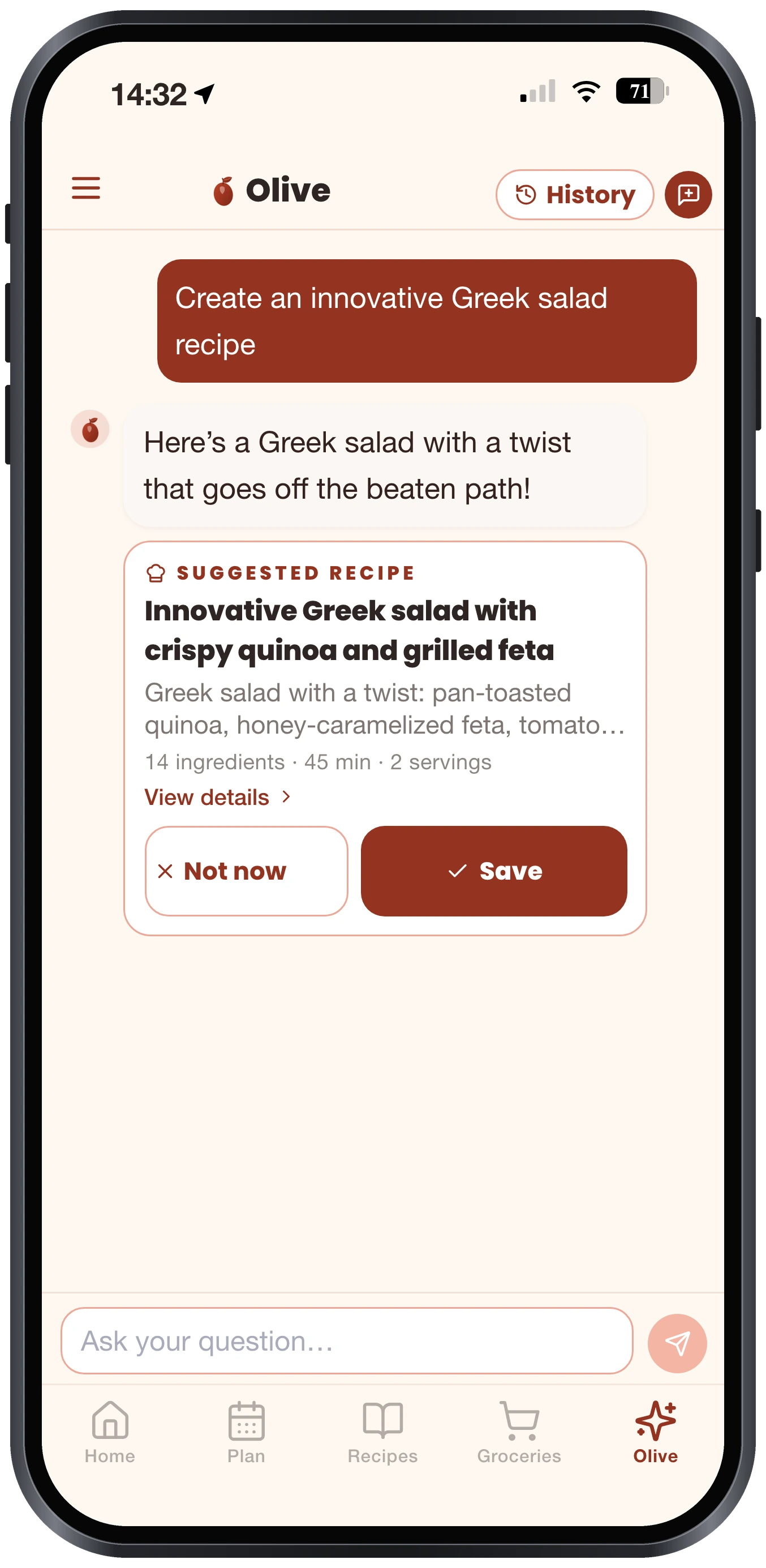
In Olivi, the generator is called Olive. You write to her like you would to someone who knows your kitchen: “I’ve got salmon and asparagus, there are three of us, 25 minutes.” She already knows your profile, meaning your allergies, diet, household size and equipment, so you don’t have to repeat it every time (chatting with Olive). If you mostly want tonight’s answer, see what Olive suggests for dinner.
Before writing, Olive draws on our recipe catalogue so she starts from proportions that hold up instead of inventing from scratch. The nutrition facts you see aren’t guessed by the AI: they come from a calculation on the Canadian Nutrient File, the reference database published by Health Canada. And if you keep your pantry up to date, she can use it to suggest what you can cook without another trip to the store.
The recipe you keep lands in your meal planner, and its ingredients join your grocery list, sorted by aisle. It all works on olivi.ca and in the mobile app.
Frequently asked questions
What is an AI recipe generator?
It’s an artificial intelligence tool that writes a complete recipe, with ingredients, quantities and steps, from a written request: ingredients to use, a craving, a time limit or an allergy. Unlike a recipe search engine, it composes a new recipe that fits your situation.
Can I generate a recipe from the ingredients I already have?
Yes, that’s the most common use. List what you have, add your time, equipment and number of people, and the AI builds a dish around it. It’s also a good way to use up food before it spoils.
Are AI-generated recipes reliable?
For a weeknight meal, most turn out well as long as you check four things: sensible quantities, ingredients in the steps that also appear in the list, believable cooking times and meat cooked to a safe temperature. For baking or a dinner with guests, a tested recipe is still the safer choice.
How is it different from an ingredient search site?
An ingredient search site finds existing recipes that contain what you have, and one or two items are often missing. An AI generator writes a recipe from exactly what you have and adjusts it on request, but that recipe hasn’t been tested yet.
Is Olivi’s recipe generator free?
You can create an Olivi account at no cost and try Olive on the web and in the mobile app. The pricing page explains what each plan includes.
Related articles
Where to next
Let Olive plan your week
Olivi builds your menu and generates your grocery list automatically, sorted by aisle. Free forever plan, no credit card.
Get the appGet the appAlso worth reading: AI cooking assistant: what Olive actually does in your recipe app · Olivi is on the App Store: the recipe and meal planner app for iPhone, iPhone Duo and iPad